


Reading time: 4 minCystitis generally refers to a whole range of conditions that don't always fall under this umbrella. Let's clarify what this condition actually is and how to prevent it.
There cystitis is an inflammation of the urinary bladder, in the majority of cases, related to infection by microorganisms common to the human body but which should not be in that specific location.
It is generally more common in the female sex (as the anatomical conformation makes it much easier for microorganisms to reach the bladder), in subjects with intestinal problems and in the subjects with a suboptimal immune response (for example, those undergoing particular therapies).
Leaving aside the obvious analysis of why the anatomical differences make cystitis more frequent in female subjects (the bacteria have to travel a shorter route), it remains interesting to understand why those who show a intestinal problem generally has a higher risk of manifestation.
What causes cystitis?
Starting from the assumption that we are faced with a problem of predominantly bacterial nature, it is easy to understand how a non-optimal functioning of the intestine, as for example in the case of constipation or alternating bowel movements (constipation alternating with diarrhea), can alter the general balance.
As a result, the bacterial species that usually populate the intestine can take over and, once they have grown in number, go to colonize other areas of the intestine as well.
For this reason it is clear that the first intervention to be done in the case of recurrent cystitis is to regulate the intestine, through the use of appropriate nutraceutical supports with a prebiotic effect.
Once this is done (when the intestinal field is rebalanced) it is possible to proceed with a second-level nutraceutical intervention, aimed at directly attacking the microorganisms responsible for the infection.
Effective remedies for cystitis: Urocyst Active line
To combat cystitis and candidiasis of the urinary tract, Nutrifarma proposes the Urocyst Active LineThere are two new allies for urinary tract health, characterized by the presence of active ingredients of the highest quality and concentration, available in two different pharmaceutical formats capable of meeting the intake needs of the widest possible public: Urocyst Active Sachets And Urocyst Active Capsule.
What distinguishes the line from the wide range of market proposals is the presence in both products of Anthocran® Phytosome®: highly standardized Cranberry extract that guarantees the maximum supply of PAC-A proanthocyanidins, essential for the treatment of urinary tract infections.
The advantage of Anthocran® Fitosoma® is that it improves the bioavailability of cranberry, ensuring absorption 3 times higher than normal extract, thus maximizing the effect of the active substances.

Anthocran® Phytosome®
Anthocran® Phytosome® agisce in 3 modi:
- inhibitory action carried out by proanthocyanidins which, by binding to the P-type fimbriae of bacteria such as Escherichia coli, inhibit their ability to colonize the urinary tract. (Bibliography 1, 2)
- preventive action against urinary tract infections, including Candida and yeast infections. Studies show that this action is made possible by the polyphenols present in cranberries, which enable the production of urinary metabolites. (Bibliography 3, 4)
- antiviral action Cranberry polyphenols have nonspecific anti-infective potential. International studies have demonstrated their ability to inhibit the virus-target cell binding, thus reducing viral activity. (Reference 5)
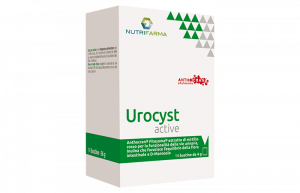 Urocyst Active sachets combine with Anthocran® Phytosome®Inulin which allows for better intestinal transit and the development of bacteria that promote the health of the digestive and urinary systems (6) and the D-mannose, a monosaccharide isomer capable of binding to the type 1 fimbriae of bacteria such as Escherichia coli, which in synergy with the Cranberry they inhibit its ability to colonize the urinary tract.
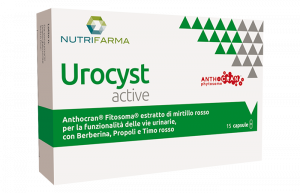 Urocyst Active capsule Anthocran® Phytosome® adds plant extracts with proven efficacy against urinary tract problems. The formulation includes Propolis with antiseptic, antimicrobial, anti-inflammatory and anesthetic action (7,8), the Berberine, traditionally used to combat urinary and digestive tract infections, and theThyme essential oil, effective in counteracting uropathogenic bacteria (9-10).
Bibliography:
- Cotellese R, Ledda A, Belcaro G, Cesarone MR, Scipione C, Scipione V, Dugall M, Feragalli B, Riva A, Allegrini P, Petrangolini G, Togni S. Anthocran® Phytosome®: Prevention of Recurring Urinary Infections and Symptoms after Catheterization. J Diet Suppl. 2023;20(1):55-67. doi: 10.1080/19390211.2021.1972074. Epub 2021 Oct 10. PMID: 34632933.
- Sihra N, Goodman A, Zakri R, Sahai A, Malde S. Nonantibiotic prevention and management of recurrent urinary tract infection. Nat Rev Urol. 2018 Dec;15(12):750-776. doi: 10.1038/s41585-018-0106-x. PMID: 30361493.
- Bresciani L, Di Pede G, Favari C, Calani L, Francinelli V, Riva A, Petrangolini G, Allegrini P, Mena P, Del Rio D. In vitro (poly) phenol catabolism of unformulated- and phytosome-formulated cranberry (Vaccinium macrocarpon) extracts. Food Res Int. 2021 Mar;141:110137. doi: 10.1016/j.foodres.2021.110137. Epub 2021 Jan 18. PMID: 33642004.
- Baron G, Altomare A, Regazzoni L, et al. Profiling Vaccinium macrocarpon components and metabolites in human urine and the urine ex-vivo effect on Candida albicans adhesion and biofilm-formation. Biochem Pharmacol. 2020;173:113726. doi:10.1016/j.bcp.2019.113726.
- Bernier C, Goetz C, Jubinville E, Jean J. The New Face of Berries: A Review of Their Antiviral Proprieties. Foods. 2021;11(1):102. Published 2021 Dec 31. doi:10.3390/foods11010102
- Collado Yurrita LSan Mauro Martín I, Ciudad-Cabañas MJ, Calle-Purón ME, Hernández Cabria M. Effectiveness of inulin intake on indicators of chronic constipation; a meta-analysis of controlled randomized clinical trials. Nutr Hosp. 2014 Aug 1;30(2):244-52. doi: 10.3305/nh.2014.30.2.7565. PMID: 25208775.
- Lavigne JP, Vitrac X, Bernard L, Bruyère F, Sotto A. Propolis can potentialise the anti-adhesion activity of proanthocyanidins on uropathogenic Escherichia coli in the prevention of recurrent urinary tract infections. BMC Res Notes. 2011 Nov 29;4:522. doi: 10.1186/1756-0500-4-522. PMID: 22126300; PMCID: PMC3261219.
- Ranfaing J, Dunyach-Remy C, Louis L, Lavigne JP, Sotto A. Propolis potentiates the effect of cranberry (Vaccinium macrocarpon) against the virulence of uropathogenic Escherichia coli. Sci Rep. 2018 Jul 16;8(1):10706. doi: 10.1038/s41598-018-29082-6. PMID: 30013052; PMCID: PMC6048107.
- Loose M, Pilger E, Wagenlehner F. Anti-Bacterial Effects of Essential Oils against Uropathogenic Bacteria. Antibiotics (Basel). 2020 Jun 25;9(6):358. doi: 10.3390/antibiotics9060358. PMID: 32630444; PMCID: PMC7344393.
- Paiano RB, de Sousa RLM, Bonilla J, Moreno LZ, de Souza EDF, Baruselli PS, Moreno AM. In vitro effects of cinnamon, oregano, and thyme essential oils against Escherichia coli and Trueperella pyogenes isolated from dairy cows with clinical endometritis. Theriogenology. 2023 Jan 15;196:106-111. doi: 10.1016/j.theriogenology.2022.11.010. Epub 2022 Nov 7. PMID: 36413866


